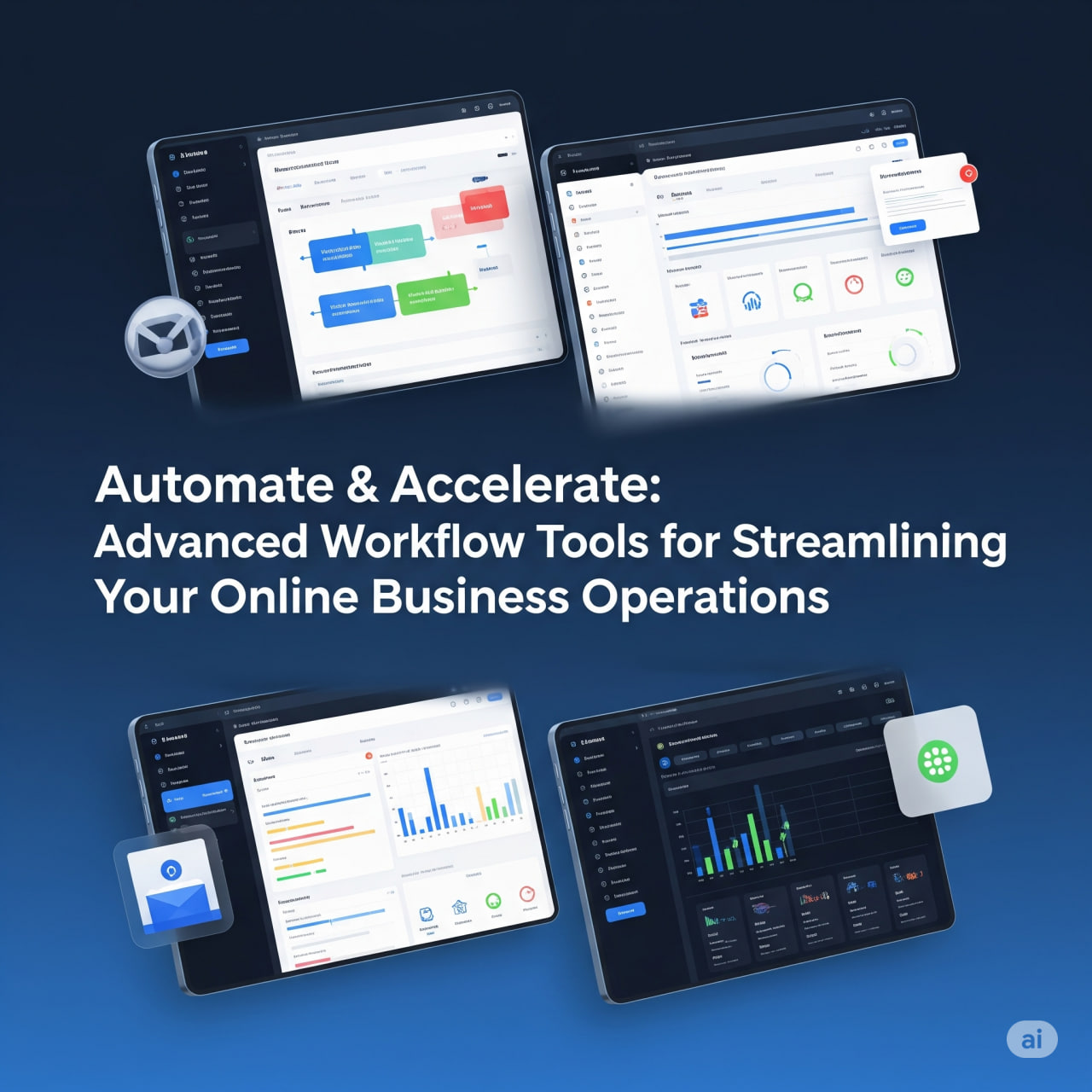
To provide the most up-to-date and comprehensive information on advanced workflow tools for streamlining online business operations, I’ll perform a Google search. In the rapidly evolving landscape of online business, automation is no longer a luxury but a necessity for streamlining operations and achieving scalability. In 2025, advanced workflow tools are increasingly powered by Artificial Intelligence (AI) and offer low-code/no-code interfaces, making them accessible to entrepreneurs without extensive technical backgrounds.
Here’s a breakdown of advanced workflow tools and strategies to automate and accelerate your online business operations:
I. Core Principles of Advanced Workflow Automation
Before diving into tools, understand the principles that underpin effective automation:
- Identify Repetitive & High-Volume Tasks: Focus on tasks that are done frequently, consume significant time, or are prone to human error (e.g., data entry, routine customer inquiries, order processing steps, social media posting).
- Map Out Processes (Current & Ideal): Visualize your current workflows step-by-step. Then, design an “ideal” automated workflow, identifying where automation can replace manual steps or decision points.
- Choose the Right Tools: Select tools that integrate seamlessly with your existing tech stack and offer the specific automation capabilities you need. Consider scalability, ease of use (no-code/low-code), and AI features.
- Start Small, Scale Gradually: Implement automation in phases. Test small, high-impact automations first, gather feedback, and then expand.
- Monitor & Optimize Continuously: Automation isn’t “set it and forget it.” Regularly monitor performance, identify bottlenecks, and refine your workflows to ensure efficiency and adapt to changing business needs.
- Human-in-the-Loop: Not everything can or should be fully automated. Design workflows that allow for human intervention for complex decisions, quality control, or personalized customer interactions.
II. Categories of Advanced Workflow Tools
A. Integration & Workflow Orchestration Platforms
These are the backbone for connecting disparate applications and automating multi-step processes across your entire business.
- Zapier: The market leader for connecting thousands of apps. Its strength lies in its simplicity and vast integration library.
- Advanced Uses: Multi-step Zaps (sequences of actions), Filters (only run if certain conditions are met), Paths (different actions based on different conditions), Formatter (reformat data between apps), Webhooks (trigger Zaps from virtually any web service).
- Example: When a new customer completes an order in Shopify (trigger), then create a customer record in HubSpot CRM (action 1), add them to a “New Customer” email list in Klaviyo (action 2), and send a personalized Slack notification to your fulfillment team (action 3).
- Make (formerly Integromat): Often considered more powerful for complex, conditional, and multi-branching workflows. Its visual builder allows for highly intricate scenarios.
- Advanced Uses: More granular control over data manipulation, error handling, and the ability to build sophisticated logic trees. Ideal for complex data syncing or multi-stage lead nurturing.
- Example: A customer submits a custom order request form. If the order value is over $500, send to sales for review. If under $500, automatically generate a quote and send to the customer.
- Microsoft Power Automate: For businesses heavily invested in the Microsoft ecosystem (Microsoft 365, Dynamics 365, Azure). Offers robust AI capabilities and seamless integration with Microsoft apps.
- Advanced Uses: Building complex flows that interact with SharePoint, Excel, Teams, and Power Apps. Can integrate with Robotic Process Automation (RPA) for automating desktop applications.
B. Business Process Management (BPM) & Automation Suites
These platforms offer more comprehensive tools for designing, executing, monitoring, and optimizing end-to-end business processes, often with low-code development.
- Pipefy: An AI-powered workflow automation software known for its intuitive visual interface, making it easy to create and scale custom workflows for various departments (HR, IT, Finance, Marketing). It focuses on managing structured and unstructured processes.
- Kissflow: A user-friendly platform for streamlining and automating business processes, often incorporating generative AI and conversational components for process design.
- Appian: A low-code platform for building applications and automating complex business processes end-to-end. It emphasizes speed of development and intelligent automation.
- Nintex Process Platform: Offers AI-powered automation capabilities for process intelligence and automation, suitable for both cloud and on-premise deployments.
- Monday.com / ClickUp / Asana: While primarily project management tools, their advanced automation features allow you to:
- Automate task assignments based on status changes or deadlines.
- Set up reminders and notifications for critical milestones.
- Integrate with communication tools (Slack, Teams) for automated updates.
- AI Power-Up: Many now include AI assistance for summarizing tasks, generating updates, or even suggesting automation rules.
C. Robotic Process Automation (RPA)
For automating highly repetitive, rule-based tasks that often involve interacting with desktop applications or legacy systems (e.g., data entry from one system to another).
- UiPath: A leading RPA platform that uses AI and machine learning to automate repetitive tasks, offering tools for discovering automation opportunities and building bots.
- Automation Anywhere: Another major player in RPA, providing an AI-powered, cloud-native platform for automating business processes at scale.
D. Specialized Automation Tools with AI
Many niche tools now offer advanced automation specific to their function, often with AI integration.
- CRM & Marketing Automation (e.g., HubSpot, ActiveCampaign, Salesforce):
- Lead Nurturing: Automated email sequences triggered by lead behavior.
- Sales Playbooks: Automate task assignments and follow-ups based on sales stage.
- Customer Service: Route inquiries, automate responses, and prioritize tickets based on urgency using AI.
- HubSpot’s Marketing Automation Software: Streamlines marketing efforts, automates repetitive tasks, and manages customer relationships.
- E-commerce Automation (e.g., Klaviyo, Shopify Flow, ReCharge):
- Abandoned Cart Recovery: Send automated, personalized emails/SMS.
- Post-Purchase Flows: Automated emails for reviews, cross-sells, or loyalty programs.
- Inventory Alerts: Notify you or even suppliers when stock is low.
- Customer Segmentation: Automatically segment customers based on purchase history, creating targeted campaigns.
- Financial Automation (e.g., QuickBooks Online, Xero, Expensify):
- Automate invoicing, expense tracking, reconciliation, and payment reminders.
- Customer Support (e.g., Zendesk, Intercom, Gorgias):
- AI Chatbots: Handle common queries, provide instant answers, and route complex issues to human agents.
- Ticket Triage: Automatically categorize and prioritize support tickets based on keywords and sentiment.
- Automated Knowledge Base: AI-driven knowledge bases that self-serve customer inquiries.
- Content & Creative Automation (e.g., Jasper.ai, Canva, Designs.ai):
- AI Writing Assistants: Generate blog posts, product descriptions, social media copy, and email drafts.
- Design Automation: AI-powered tools that assist with logo creation, video production, and social media content generation, often suggesting designs based on prompts.
- HR & Onboarding Automation (e.g., BambooHR, Workday):
- Automate new hire paperwork, task assignments, and introductory communications.
III. Best Practices for Implementing Workflow Automation
- Define Clear Objectives & KPIs: What do you want to achieve? (e.g., reduce customer service response time by 30%, increase lead conversion rate by 15%).
- Document Everything: Create visual maps (flowcharts) of your current and desired processes. This clarifies steps and helps identify inefficiencies.
- Ensure Data Consistency: Clean and standardized data across all your systems is crucial for automation to work correctly.
- Integrate Systems Seamlessly: Prioritize tools with robust API capabilities and pre-built integrations. This prevents data silos and ensures smooth information flow.
- Test Thoroughly: Before full deployment, rigorously test every step of your automated workflows to catch errors and ensure desired outcomes.
- Train Your Team: Automation frees up time, but employees need to understand the new processes and how to interact with the automated systems. Address any resistance to change.
- Focus on Value, Not Just Task Elimination: Automation should contribute to business growth, better customer experience, or strategic advantage, not just cutting costs.
- Prioritize Security & Compliance: Ensure your automation tools comply with relevant data privacy regulations (e.g., GDPR, CCPA) and have strong security features.
- Iterate & Improve: Business needs change. Regularly review your automations, collect feedback, and be prepared to refine or rebuild workflows.
By strategically adopting these advanced workflow tools and adhering to best practices, online entrepreneurs can dramatically streamline their operations, reduce manual effort, minimize errors, and free up valuable time to focus on strategic growth and innovation.